The Journey
Motivations for the Beyond the Dialogues Project
The 2021 United Nations Food Systems Summit and Associated Dialogues in Ghana
It has become increasingly apparent in the 21st Century that the earth’s food systems are unsustainable for both humans and the planet, and hence should be transformed. Many agree that food systems transformation will require deep and radical shifts in the way food is produced, consumed, and how its associated bye products are disposed of or up-scaled. Such transformation must respond to the multiple intersecting challenges (Laar et al., 2023). Building on existing initiatives aimed at transforming food systems, the United Nations Secretary-General in 2021, convened the United Nations Food Systems Summit (UNFSS), hoping to inspire urgency and action towards transforming food systems globally (UNFSS & AUDA-NEPAD, 2021). Although contexts and needs undoubtedly differ – globally, across the African continent, at the sub-regional or country levels, the commitments to transform food systems were expected to respond to at least five action areas.
The five agreed action areas to inform food systems transition and transformation
- “Nourishing all people” (including ensuring access to safe and nutritious food for all, promoting and creating demand for healthy and sustainable diets, and reducing waste).
- “Boosting nature-based solutions” (acting on climate change, reducing emissions and increasing carbon capture, regenerating and protecting critical ecosystems and reducing food loss and energy usage, without undermining health or nutritious diets).
- “Advancing equitable livelihoods, decent work and empowered communities” (raising incomes, distributing risk, expanding inclusion, creating jobs, and adding value).
- “Building resilience to vulnerabilities, shocks and stresses” (ensuring the continued functionality of healthy and sustainable food systems).
- “Accelerating the means of implementation” (including finance, science and innovation, data, governance, and trade).
Ghana’s journey toward food systems transformation
In Ghana, the UNFSS and the Dialogues that preceded it, galvanized diverse food systems actors and stakeholders to take action on transforming Ghana’s food systems. A synthesis paper documents the insights from the food systems dialogues convened by the government of Ghana as well as others independently implemented by non-state actors as part of the UNFSS Dialogues (UNFSS, 2021; “Ghana Food Systems Summit Dialogues Synthesis Papers”, 2022). The goal of the Food Systems Dialogues and Summit is to transform the global food systems, and therefore Ghana’s – in support of the 2030 Agenda (see Fig1)

To move from Stage 4 to Stage 5, challenges must be overcome. From a long list of Ghana’s food system challenges (see Box 1), Ghana food systems stakeholders identified key challenges relating to food production; assuring healthy and sustainable food consumption; gaps in policies and actions supportive of an integrated food systems agenda.
The Commitments
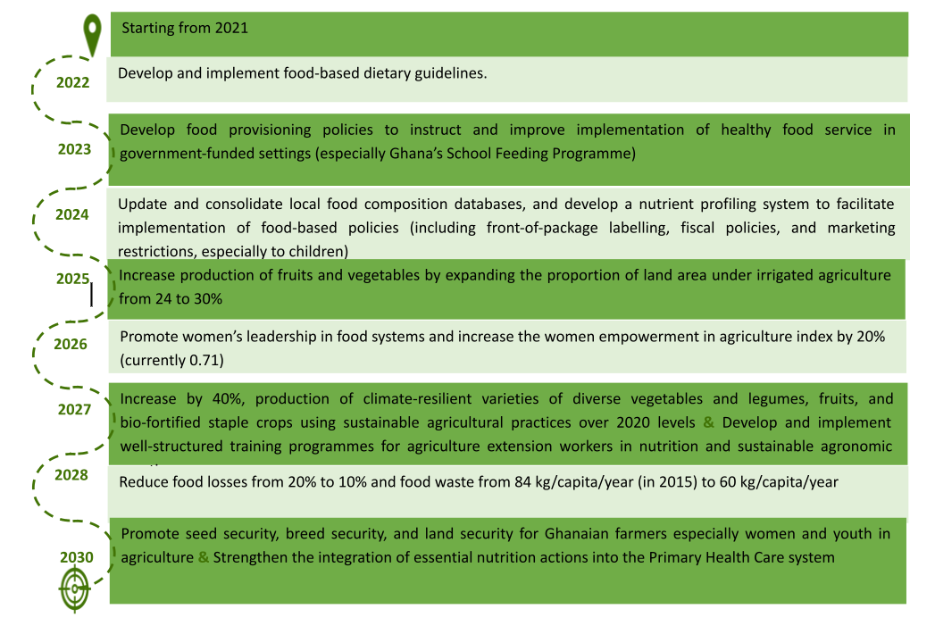
Overall, the UNFSS Dialogues and the Summit catalysed clarity on the need and urgency for food systems transformation to achieve sustainable healthy diets for all Ghanaians. The process motivated National Commitments (see Fig2) to achieving the following Food Systems Transformation targets by 2030.
Following the UNFSS in September 2021 wherein the above commitments were delivered, Ghana updated the Commitments and submitted a set of 17 Commitments (See Box 3) to the Nutrition for Growth(N4G) Summit held in Tokyo, Japan in December 2021. These set of Commitments are in line with national priorities to transformation Ghana’s food systems, and the N4G Principles of Engagement. Several of the commitments are aligned with the SDG targets to be achieved by 2030, as well as targets linked to the World Health Assembly – to be achieved by 2025.
By 2025, the Government of Ghana will increase the percentage of early initiation of breastfeeding within 1 hour from 52%... (Click to read more)
By 2025, the Government of Ghana will reduce all forms of malnutrition; including the prevalence of stunting in children under... (Click to read more)
By 2024, the Government of Ghana will increase maternity leave to 14 weeks to be implemented across all sectors of... (Click to read more)
By 2022, the Government of Ghana will develop and implement a comprehensive Food and Nutrition Security Strategy, which will lead... (Click to read more)
By 2023, the Government of Ghana will develop and implement food-based dietary guidelines that define context-specific sustainable healthy diets; and... (Click to read more)
By 2024, the Government of Ghana will compile, consolidate, and update local food composition databases, and develop a nutrient profiling... (Click to read more)
By 2028, the Government of Ghana will reduce food losses and food wastes from 20% to 10% and from 84... (Click to read more)
By 2030, the Government of Ghana will achieve seed security, breed security and land security for Ghanaian farmers, especially women... (Click to read more)
By 2023, the Government of Ghana will jointly agree with multilateral agencies, civil society, and donors on coordination and oversight... (Click to read more)